
— Artist Process
The Archive of Memory: Collecting Images, Experiences, and Time
“This title connects the physical act of collecting vintage imagery with the deeper process of collecting experiences throughout a lifetime.”


— Artist Process
The Archive of Memory: Collecting Images, Experiences, and Time
“This title connects the physical act of collecting vintage imagery with the deeper process of collecting experiences throughout a lifetime.”
My artwork begins long before I pick up a spray can, cut into a magazine, or place an image onto a canvas. It begins with the collection of experiences that have accumulated throughout my life. Memories of my youth, the influence of my parents, music, places I have been, images I have encountered, and ideas that have stayed with me all contribute to the visual language I continue to develop.
Over time, these experiences become an internal archive. Some remain vivid and immediate, while others settle somewhere deeper in the mind, resurfacing unexpectedly through a photograph, a phrase, a familiar typeface, or an image from a forgotten magazine. I may not always recognize the connection immediately, but I understand that these fragments carry meaning.
Not every memory is sentimental, and not every image takes me somewhere I want to return to. Some experiences remain distant. Others carry a sense of familiarity that is difficult to explain. I am interested in that tension: the way an image can feel recognizable without revealing the entire story behind it.
My paintings become a place where these fragments can coexist. They do not need to follow a chronological order or resolve into a single narrative. Instead, they reflect the way memory actually works: layered, interrupted, sometimes unclear, and continually changing as new experiences accumulate.

When I collect magazines, I am not necessarily looking for a particular image or subject. Sometimes it is a photograph that catches my attention. Other times, it is a fragment of typography, a color combination, a graphic detail, or a phrase that seems to resonate with something already stored in my mind. I may not know exactly why a particular element interests me, but I recognize its potential.
I think of these materials as fragments of a larger visual history. Each page contains evidence of the tastes, ambitions, and attitudes of the period in which it was produced. Fashion, advertising, popular culture, and graphic design all reveal something about the society that created them. By cutting, rearranging, and layering these elements, I can remove them from their original context and allow them to take on a new identity.
The process is intuitive, but it is not entirely accidental. I am responding to the relationships between images, the energy of the typography, the contrast between colors, and the way one fragment interacts with another. A photograph that once existed to sell a product might become part of a composition about identity, memory, or the passage of time. A discarded headline can become a visual statement whose meaning changes when it is placed alongside graffiti and other collected imagery.
What interests me most is that these materials have already lived a life before entering my work. They have passed through another time, another context, and another set of intentions. I am not simply preserving them. I am transforming them, allowing fragments of the past to participate in something new.


Typography has always held a particular place in my visual world. Words are meant to communicate, but their appearance can communicate something entirely different before we even begin to read them. The weight of a letter, the shape of a typeface, the arrangement of a headline, or the imperfect texture of printed ink can carry the personality of an entire era. Sometimes, the visual character of a phrase is just as important to me as the words themselves.
Music works in a similar way. A particular sound can transport me to another period of my life, bringing back a place, a feeling, or a moment that I had not consciously revisited in years. Those associations are rarely isolated. Music becomes connected to the imagery, clothing, design, and cultural attitudes of the time. One memory leads to another, and suddenly a whole period of life seems to exist within a single reference.
Consumer culture is another part of this visual history. The magazines I collect were filled with images designed to create desire, define lifestyles, and sell an idea of how people should look, live, and aspire to be. I find it interesting to take those images out of their original commercial setting and place them within a different context. What was once intended to sell something can become a fragment of a much larger personal narrative.
When I combine these references with graffiti, the work brings together two distinct visual languages. The polished imagery of advertising and editorial photography meets the directness, urgency, and physical energy of marks made by hand. Typography can become an anchor, a disruption, or simply another fragment competing for attention within the composition.
These influences do not always arrive as conscious decisions. Sometimes a typeface reminds me of a period in my youth. Sometimes an image recalls the music, attitudes, or visual culture that surrounded me. Other times, I am responding purely to the formal qualities of an image or a letterform. Meaning can emerge gradually, through the relationships that develop as the work takes shape.
For me, this is where cultural memory becomes personal. The imagery belongs to a broader history, but the associations I bring to it are my own. By combining these fragments.
I do not approach my work with the intention of illustrating my life story. Instead, pieces of that story find their way into the process through the materials I choose and the relationships I create between them. A photograph, a phrase, or a particular graphic element might connect to something familiar, even when I cannot immediately identify the memory behind it. These associations become part of the work without requiring a literal explanation.
This is one of the reasons collage continues to interest me. It allows me to bring together fragments that originated in different places, different periods, and different contexts. An image from a vintage magazine might carry the visual character of another era, while a layer of graffiti introduces a more immediate, physical response. Paint, typography, and found imagery begin to interact, creating a composition that reflects more than any individual element could express on its own.
In many ways, the process resembles the way I understand my own history. Our experiences do not remain neatly separated. The past continually influences the present, sometimes in ways we recognize and sometimes in ways we only begin to understand later. Memories overlap, perspectives change, and familiar things acquire new meanings as we move through life.
I am not interested in making every piece a personal confession. I want the work to retain a sense of independence, allowing the viewer to encounter it through their own experiences. The images and materials come from a world I recognize, but once they become part of the composition, they can suggest something beyond my original associations.
That balance is important to me. My history provides the starting point, but the artwork must become something in its own right. It needs its own visual structure, its own tension, and its own presence. The personal meaning may be embedded in the layers, but it is the completed work that allows those fragments to communicate with someone else.

Memory has a complicated relationship with time.
There are memories I can revisit with a sense of familiarity, and others that seem to exist somewhere beyond my immediate reach. Both find a place in the way I think about my work.
I am drawn to vintage imagery partly because it carries this same sense of distance. The photographs, advertisements, and typography I collect belong to moments that have already passed. They preserve something of their original time, but they can never fully return us to it. We encounter them through the present, bringing our own experiences and interpretations to what we see.
Nostalgia is part of that experience, but it is not the whole story. An image can remind us of something beautiful while also revealing how much has changed. A familiar phrase can evoke a period of life that feels impossibly far away. Even an image that initially seems ordinary can acquire meaning when it becomes connected to a person, a place, or an experience we have carried with us for years.
Sometimes I know immediately why an image appeals to me. Other times, I respond to it instinctively, without needing to explain the connection. As the image enters a composition and interacts with other fragments, its significance may shift. What began as a visual attraction can develop into something more personal, or it can remain deliberately ambiguous.
This uncertainty is part of what makes the process worthwhile. I do not need every memory to resolve into a clear narrative, and I do not want every image to dictate how a painting should be understood. The layers can hold contradictions. Familiarity can exist alongside distance, beauty alongside discomfort, and fragments of the past alongside marks made entirely in the present.
Perhaps that is what I am ultimately collecting: not simply images from another time, but the changing relationships I have with them. The past is never entirely fixed in our minds. We revisit it from different places in our lives, and what we see in it changes with us.

When I begin working on a canvas, I am bringing together materials that carry different histories.
The process is a conversation between intention and discovery. I make decisions about placement, color, scale, and contrast, but I also respond to what happens as the painting develops. An image that initially feels essential may eventually be covered. A fragment of text might become more powerful when only part of it remains visible. A layer of graffiti can interrupt the composition, redirect the eye, or connect separate elements that previously felt unrelated.
I am interested in that transformation. The materials begin as fragments collected from the world around me, but through cutting, layering, painting, and rearranging, they become part of a new visual structure. Their original identities remain present, even as their meanings begin to change.
The physical surface matters just as much as the imagery. The edges of the collage, the density of the paint, the movement of the marks, and the relationship between exposed and concealed areas give the work a sense of depth. These are not simply images arranged on a surface. They are layers of material that record decisions, revisions, and moments of instinct throughout the process.
Ultimately, my artwork gives me a way to communicate experiences that cannot always be expressed through words. The magazines preserve fragments of visual culture. The typography carries the language of another time. The graffiti introduces my own hand, my own energy, and my own presence into the composition. Together, these elements create a visual language shaped by everything I have collected, encountered, and carried with me.
I think of each painting as a meeting point between the past and the present. The images may come from another era, but the act of bringing them together happens now, through my own perspective and experience. Some fragments bring back vivid memories. Others remain distant, their significance only partially understood. Both belong to the same archive.
For me, the work is not about returning to the past or preserving it exactly as it was. It is about recognizing that our experiences continue to shape who we become, often in ways we cannot fully explain.
The canvas becomes a place where those fragments can meet, collide, and change. What emerges is not a record of everything I have experienced, but a reflection of the images, ideas, and memories that have stayed with me.
Even when I am working alone in the studio, I bring everything I have experienced into the process. Conversations, places, relationships, cultural references, personal challenges, and images encountered throughout the day can influence the decisions I make.
Later, a color combination might feel familiar. An image might remind me of a period in my life. A particular arrangement of shapes might trigger an association I cannot immediately explain.
Often, the studio becomes a place where these fragments can interact without needing to be organized into a clear narrative.
This is one reason I value an intuitive approach to mixed media collage. I can respond to an image, cover it, change it, or combine it with something that seems unrelated. Through those decisions, connections begin to emerge.
The painting does not need to illustrate a specific memory to be influenced by memory.
Instead, the process allows different experiences to be digested through material, color, gesture, and composition. What begins as an uncertain feeling can gradually become a physical object.
I may not have a complete explanation for every decision, and I do not think every artwork needs one. Sometimes the meaning becomes clearer only after the work is finished and I have had time to look at it from a distance.
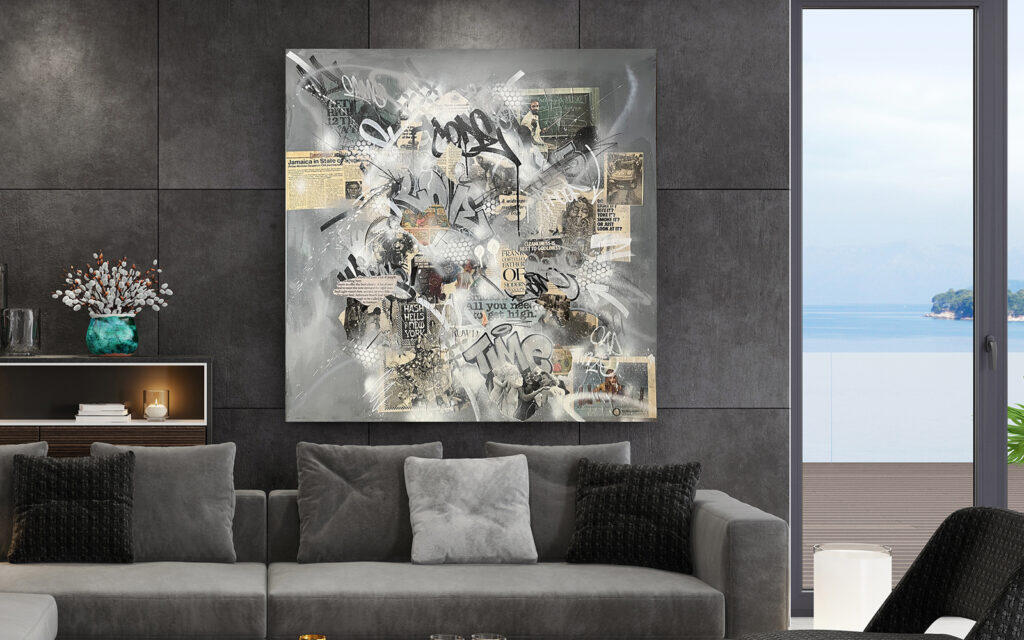
Memory, material, and the marks we leave behind.
Discover Roche Jackson’s mixed media graffiti paintings, combining vintage collage, spray paint, and layered imagery.